
We will analyze how a point charge behaves within a constant electric field, focusing on its motion or kinematics with acceleration.
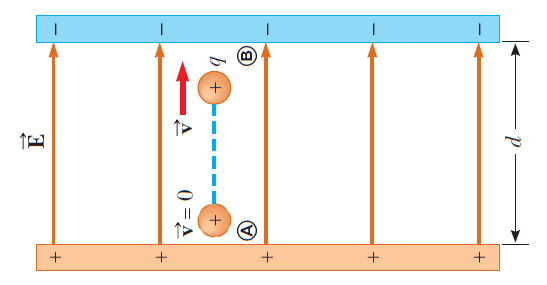
Point Charge in a Uniform Electric Field
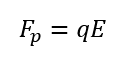
When a particle with charge q and mass m is introduced into an electric field E, the electric force exerted on the charge is given by the equation:
F = qE
If this is the only force exerted on the particle or charge, it certainly represents the net force (the force of gravity from the Earth is not taken into account), which causes the particle to accelerate according to the particle under net force model
a = qE/m
As we’ve mentioned, if the electric field is constant at any point, we can use the equations of uniformly accelerated motion:

After calculating the acceleration of the charged particle, we can use the aforementioned equations to determine its final position, the time it takes to travel from point A to point B, etc.
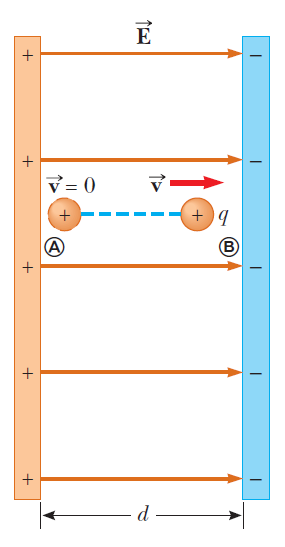
The above diagram represents two charged plates, one positively charged and the other negatively charged, separated by a distance d. Within this setup, a constant electric field E is formed between the plates at any point.
Problem 1: Displacement of an Electron in a Uniform Electric Field
An electron (q = 1.602 x 10⁻¹⁹ C) enters a region where electric charges have created an electric field of magnitude E = 2500 N/C directed to the right. The initial velocity of the electron is 2.5 x 10⁴ m/s. Determine the distance traveled by the electron until it stops.
Solution
We summarize the data to have a clearer understanding of the point charge problem in an electric field.
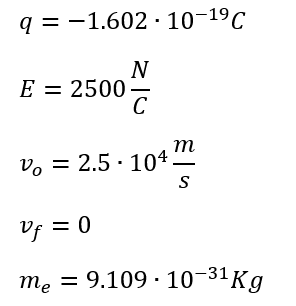
Data of the point charge problem in a uniform electric field
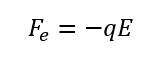
We use the following expression derived from kinematics
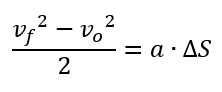
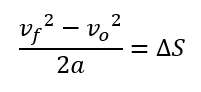
We rearrange the equation to solve for displacement:
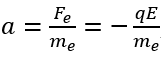
We know from Newton’s second law and combine it with the first equation:
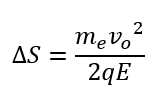
Substituting into the displacement equation, we obtain an expression that depends on the charge and the field.
Finally, we substitute the values into the equation and perform the calculations.

The distance traveled by the electron in the uniform electric field until it comes to a stop is 0.0000007 meters = 0.6 micrometers.
KNOW THE DIFFERENT TUTORING SERVICES OFFERED BY UNIVERSITY ADVISER
We have Professors in multiple specialties, who adapt to your needs as a University Student, High School, Undergraduate, Master’s, and Doctorate.


Problem 2: The acceleration of a proton in an electric field
A proton (q = 1.602 x 10^-19 C) enters a region where an electric field of magnitude E = 5000 N/C directed to the right has been created. The proton’s initial velocity is 1.5 x 10^4 m/s. Determine the acceleration experienced by the proton in the electric field.
Solution
We summarize the data to have a clearer understanding of the proton’s problem in an electric field.
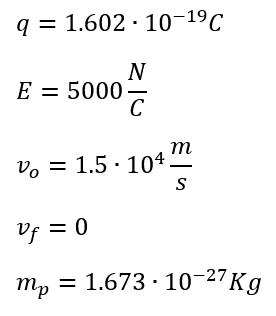
Data of the problem of a proton in a uniform electric field
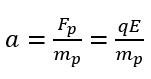
Taking into account Newton’s second law and combining it with the previous equation:
Finally, we substitute the values into the equation and perform the calculations.
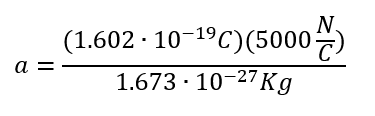
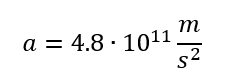
The acceleration experienced by the proton in the electric field is 480,000,000,000 m/s².

Do you need help with your physics assignments, tasks, and university work? At University Advisor, you can find the right professor or tutor to help you with your physics university assignments.
Problem 3: The time of a proton in an electric field
A proton (q = 1.602 x 10⁻¹⁹ C) enters a region where an electric field E directed to the right has been created. The proton’s acceleration is 4.8 x 10¹¹ m/s2. Calculate the time it takes for the proton to travel through the electric field until it comes to a stop, if its displacement is 0.8 x 10⁻⁶ m.
Solución
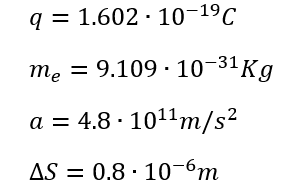
First, we calculate the initial velocity v0. We know that
We rearrange the equation to solve for v0. When the proton reaches the end of the displacement, the final velocity is zero, so:
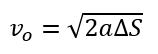
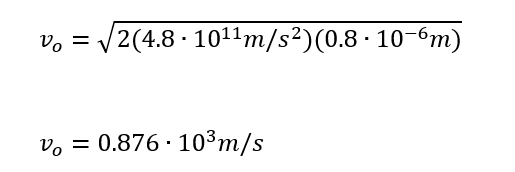
We substitute the values to calculate the initial velocity of the proton in the uniform electric field.
Now we can calculate the time it takes for the proton to reach the end of the electric field until it comes to a stop. We use the following equation:
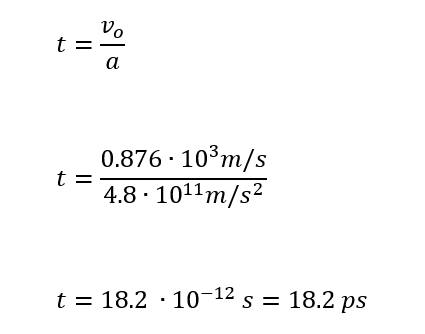
Consequently, the time is 18.2 picoseconds, an extremely fast displacement.
For more information on how to solve problems involving uniform electric fields, we recommend the following tutorial.
Do you need help with your physics assignments, tasks, and university work? At University Adviser, you can find the right professor or tutor to help you with your physics university assignments.
Asesor Universitario
If you want to learn more about physics topics, visit our available content.
References
- Serway, R. A., & Jewett, J. W. (2009). “Physics for Scientists and Engineers with Modern Physics,” 7th Edition. Vol. 1 and 2. Mexico City: Cengage.
- For further illustration, visit Wikipedia: Electric Field.